Form 8233 is for nonresident aliens. It lets them not have U.S. federal income tax withheld. This is when a tax treaty or other rule allows it.
It helps avoid extra withholding and speeds up refunds. This is important for both the payer and the payee.
The nonresident fills out IRS Form 8233 and gives it to the withholding agent. This is usually the employer. The agent checks and signs it, then sends it to the IRS within five days.
This follows the IRS rules and Internal Revenue Code. It’s part of the instructions. You can find the official IRS details here: IRS Form page.
Each year, each withholding agent, and each income type needs a new Form 8233. Check the U.S. tax treaty to see if you qualify. Many treaties have special rules for entertainers and athletes. If you fall into this category, see our full Athlete Tax Guide for 2025 for detailed tax rules.
Following the form instructions carefully helps avoid delays. It also makes sure the withholding is correct.
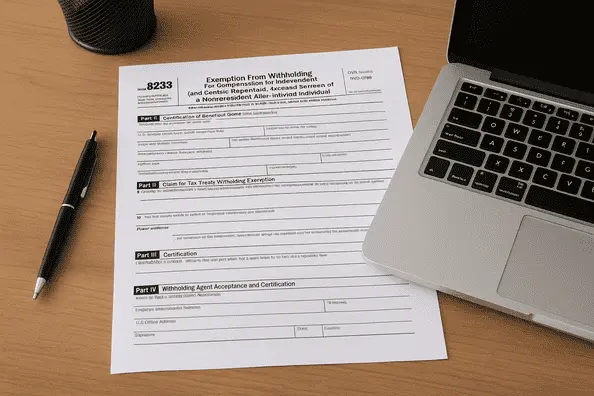
Who qualifies and IRS rules for withholding exemptions
Form 8233 helps nonresident aliens get a withholding exemption for US services pay. It’s a claim form for tax treaties or personal exemptions. It tells payers if they can lower withholding at payment time.
What is Form 8233 and what it’s used for: It is for nonresident aliens to avoid withholding on services pay. It’s for fees, wages, and some scholarships. But, it’s not for noncompensatory scholarships.
Who needs to file and eligibility rules: Nonresident aliens with US-sourced pay must file for treaty benefits. They must meet treaty residency tests and conditions. The IRS guides withholding agents on Form 8233 acceptance.
Types of income covered: independent contractors vs dependent personal services: it covers contractor and employee pay. Contractors get fees for self-employment. Employees get wages and scholarships. If you also earn income from real estate, make sure your bookkeeping stays accurate.
Tax treaty withholding exemptions and limits: Tax treaties offer exemptions but with limits. These include day-count rules or stay durations. Countries like Canada and India have special rules. If eligibility is unsure, the IRS Form 8233 may not stop withholding. Refunds can be sought after filing if the IRS agrees.
How to complete, submit, and support Form 8233 — instructions and practical filing tips
This section covers how to fill out Form 8233 and avoid mistakes. It gives clear instructions for claimants and employers. It explains when to file and how often.
Completing the form: key parts and required information
When filling out Form 8233, claimants must enter the tax year in Part I. Part I asks for name, country of citizenship, and U.S. ID number. Part II requires a brief statement about services, dates, and compensation.
Part IV is for the withholding agent with their name, address, and EIN. Claimants must sign and certify the information.
Documentation to attach and employer responsibilities
Attachments depend on the treaty and claim type. You might need a passport, visa, or proof of residency. Employers must check the documents, confirm they’re correct, and sign Part IV.
They must also send the form to the IRS within five days and keep a copy.
Difference between Form 8233 and other forms (W‑8BEN, W‑4, W‑9)
Form 8233 is for personal services income and needs IRS submission. W‑8BEN is for passive income and is held by the payor. U.S. persons use W‑4 for withholding, while nonresident aliens use Form 8233 for treaty exemptions.
Form 8233 vs W‑9 shows U.S. persons use W‑9 for a TIN; nonresident aliens do not.
Each tax year and withholding agent needs a separate Form 8233. Taxpayers must renew it each year to keep treaty benefits. If circumstances change, renew Form 8233 and update the information.
Common mistakes include missing tax year, omitted treaty article, and lack of ID. To avoid delays, apply early for an SSN or ITIN if needed. Attach required documents and ensure the employer completes Part IV quickly.
Professional tax services like Sprintax or a qualified advisor can help prevent rejections and speed up processing.
Conclusion
Form 8233 is especially important for nonresident athletes. It helps you avoid unnecessary U.S. tax withholding and apply the right treaty benefits. Just confirm the correct treaty article and file a new form each year for each income type.
If you’re an athlete dealing with income from different events or countries, our athlete accounting services page offers clear guidance tailored to those situations.
Before You File Form 8233
Attach important documents like your passport and visa. If you need a Social Security number or ITIN, get it early. This avoids delays. You can read our full guide on how to get an ITIN here: W-7 Form explained.
The withholding agent must sign Part IV and send the form to the IRS within five days.
What is Form 8233 in simple terms? It’s a way to claim less federal withholding if treaty rules apply. Be careful of rules that might limit your eligibility. If you’re a business owner, you may also deal with corporate filings like Form 1120. Here is our full guide: Form 1120 explained.
For small business owners in Florida who need help with compliance, learn more here: Accounting firms for small businesses. Use good tax software to avoid mistakes and delays.
FAQ
1. Do I really need Form 8233 as a nonresident?
Yes—if you’re a nonresident earning money for services in the U.S. and a tax treaty gives you an exemption, Form 8233 is the only way to claim it upfront. Without it, the payer must withhold tax at 30%, even if the treaty says you shouldn’t be taxed.
2. How long does Form 8233 last?
It’s only valid for one tax year. Even if nothing changes, same employer, same country, same visa, you must submit a new form every year. No exceptions.
3. What happens if I don’t file Form 8233?
You’ll simply get taxed at the normal nonresident rate, usually 30%. You can still claim the treaty benefit later when you file your U.S. tax return, but it takes months to get the refund. Filing the form upfront avoids that headache.
4. How fast does the IRS process Form 8233?
The IRS doesn’t “approve” it in advance. Your employer sends it in, and unless the IRS objects within 10 business days, the treaty exemption stands. If the IRS does object, withholding must start again until the issue is fixed.
5. Can independent contractors use Form 8233?
Yes. Contractors, freelancers, visiting professors, trainers, researchers, and performers can all use Form 8233, if their country has a treaty article that covers their type of services.
6. Is Form 8233 the same as W-8BEN?
No.
- Form 8233 is for services income (wages, fees, scholarships).
- W-8BEN is for passive income (interest, royalties, dividends).
If you’re getting paid for actual work done in the U.S., Form 8233 is the correct one.
7. Do students or researchers need Form 8233?
Often yes. Many treaties have special articles for students, trainees, and researchers. If those rules apply to you, Form 8233 is how you claim the exemption with your school or employer.
8. What documents should I attach?
It depends on your treaty claim, but you normally need:
- Passport copy
- Visa page
- I-94
- Proof of residency in your treaty country
- A short statement of your services and dates
The withholding agent may request additional proof if something is unclear.
9. What if I work for more than one employer?
You need one Form 8233 per withholding agent. Two employers = two forms.
Each one must sign and mail their own copy to the IRS.
10. What if the IRS rejects the form?
You can correct the issue and re-submit. The most common mistakes are missing treaty articles, incorrect SSN/ITIN, or a mismatch in residency details. Most rejections are fixable.